Do Geishas Still Exist? Modern Geisha Culture, Rules, and History
A lot of travelers step off the train at Kyoto Station wondering if real geishas belong entirely to black-and-white history books. You walk past flashing billboard screens, convenience stores, and salarymen rushing toward subway gates. It feels almost impossible that an eighteenth-century art tradition could survive intact on the very same pavement. Yet people still ask, do geishas still exist in a world of high-speed rail and pocket Wi-Fi? The short answer is yes, absolutely, though their world is far smaller and quieter than it was eighty years ago.
Today, roughly 600 working geishas carry on this lineage across Japan, with Kyoto remaining the beating heart of the profession. Locally known as geiko in Kyoto, these women are professional artists, musicians, and conversationalists. They do not live as museum relics. They manage bank accounts, learn centuries-old shamisen chords, adjust silk robes by hand, and adapt to modern society on their own terms. If you want to understand how this fragile arts community survived wars, economic collapses, and shifting tourist crowds, you have to peel back the mystery of the flower and willow world.
Do Geishas Still Exist in Modern Japan? Numbers, Communities, and Daily Life
At their peak in the late 1920s, over 80,000 geishas worked throughout Japan. Every hot spring resort town, port, and entertainment district had teahouses echoing with the pluck of shamisen strings. World War II shattered that infrastructure. Postwar labor laws changed the legal age of training, and western-style host bars replaced old-school banquet dining for everyday business gatherings. Many people naturally assumed the tradition was dead or dying. By the early 2000s, apprentice numbers dropped to historical lows, leaving many teahouses nervous about the future.
Something interesting shifted around 2008. Young Japanese women started discovering traditional arts through the internet, documentary footage, and specialized recruiting websites set up by district associations. Instead of being pushed into teahouses by impoverished families, which was common in the nineteenth century, modern girls now apply voluntarily after finishing junior high or high school. The modern day geisha chooses this life freely. She signs up knowing she will surrender her personal smartphone during initial training, trade casual clothes for layered silk, and spend six days a week practicing posture and dialect.
Pro tip: If you want to see authentic performances without private introductions, book tickets for Kyoto's annual spring dances like the Miyako Odori in Gion Kobu, which run throughout April and cost around 5,000 to 7,000 yen.
Kyoto is home to about 250 active artists split between geiko and their teenage apprentices, called maiko. Tokyo maintains its own smaller community in districts like Asakusa, Kagurazaka, and Shinbashi, where performers are referred to simply as geisha. Kanazawa has three preserved teahouse quarters with roughly two dozen performers. You can also find tiny clusters in Niigata, Hak Hakone, and Fukuoka. While the community is tiny compared to its heyday, it is remarkably stable right now.
Book your geisha show kyoto experience:
What Is a Geisha in Japan and What Do They Actually Do?
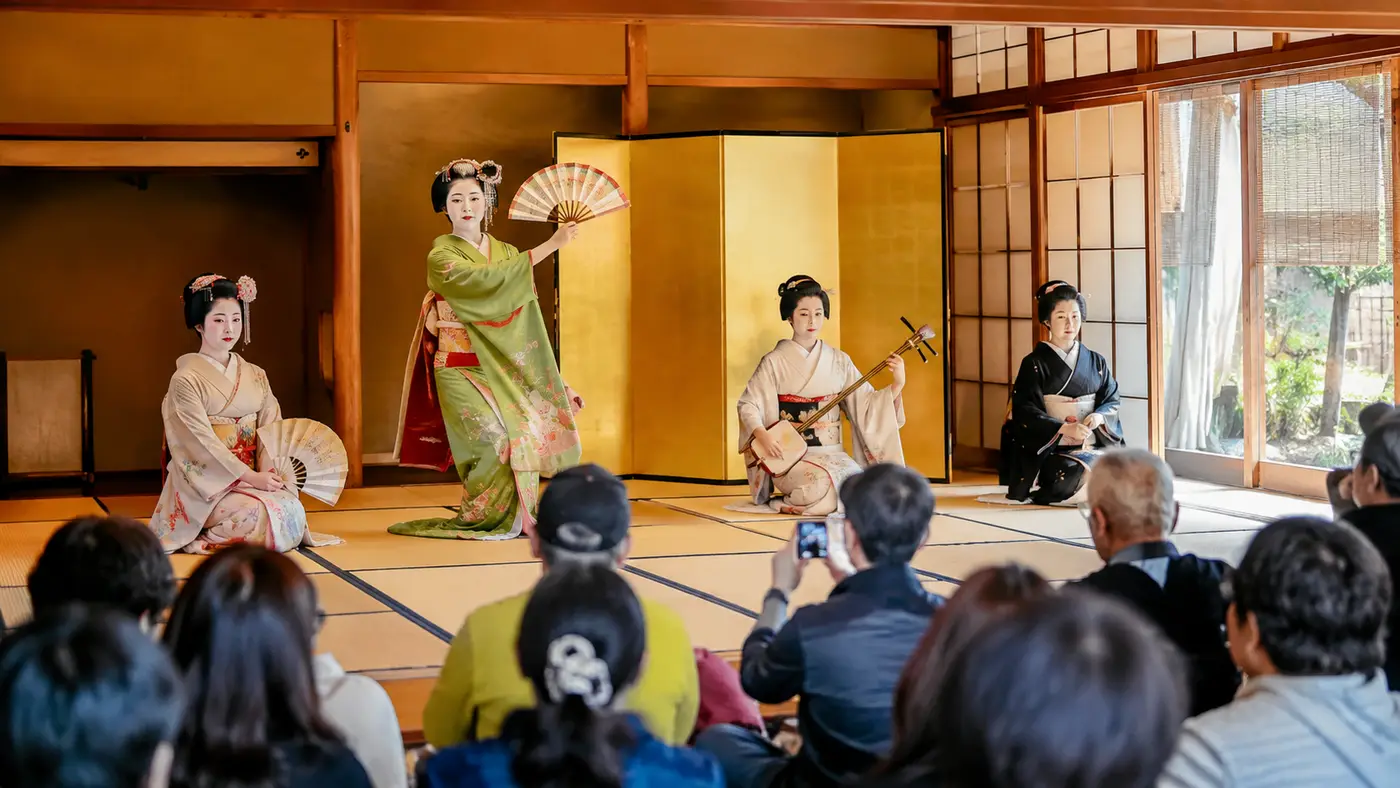
Hollywood movies and Western pulp fiction have spent decades confusing people about the true role of a japanese geisha. The word itself provides the cleanest explanation. Gei means art or performance, and sha means person. A geisha is literally a practitioner of traditional arts. For centuries, their entire livelihood has rested on their ability to entertain high-status guests at formal banquets called ozashiki through music, conversation, and classical dance.
What does an evening banquet actually involve? Guests arrive at an ochaya (teahouse), sit on tatami mats, and eat multi-course kaiseki meals. The geiko pours drinks, engages guests in lighthearted banter, tells historical anecdotes, and plays clever banquet drinking games. Halfway through the dinner, the mood shifts. One woman sits with a three-stringed shamisen while another steps onto the tatami to perform a slow, incredibly controlled geisha dance. The movement is subtle. A tilt of the wrist, a dip of the shoulder, or a flick of a paper fan carries specific narrative meaning, depicting falling maple leaves or lonely winter journeys.
The daily training behind those ten minutes of effortless dance is brutal. Most people only see the evening glamour, but a working artist spends her daylight hours running between specialized lessons:
- Nagauta singing: vocal lessons focused on epic storytelling, control, and breath support for traditional ballads.
- Shamisen practice: hours spent building tough calluses on fingertips to play complex rhythms without sheet music.
- Kyo-mai dance: rigorous posture training derived from Noh theater, practiced under the strict eye of school masters.
- Tea ceremony: learning the precise geometry of serving matcha to develop grace and economy of movement.
- Tsuzumi and taiko drums: studying traditional percussive timing used in theatrical accompaniment.
Beyond performance skills, they master the art of conversation. A veteran geiko can chat comfortably with a politician, an overseas CEO, an eccentric artist, or an awkward university student. She reads the room within five seconds of walking through the sliding screen. If conversation lags, she steps in with humor. If a guest wants quiet reflection, she sits patiently and pours sake. It is social hospitality elevated to high performance art.
The Living Quarters: What Is a Geisha House?
To understand the community, you have to understand the physical and social framework of the okiya. What is a geisha house, exactly? An okiya is a licensed residential boarding house run by an experienced woman called the okami-san, or "mother." In Kyoto's floral quarters, an apprentice lives inside the okiya alongside her house sisters throughout her training years. The house pays for her expensive hand-painted kimonos, hair ornaments, dance tuition, room, and board.
These buildings are tucked away down narrow stone alleyways. From the outside, an okiya looks like any other traditional wooden townhouse (machiya). The only giveaway is usually a cluster of small wooden nameplates hanging by the front entrance, listing the stage names of the women who live and work under that roof. Inside, living space is shared, formal, and steeped in hierarchy. Junior apprentices sleep in communal tatami rooms, wake early to clean the corridors, and learn to speak the melodious, elongated Kyoto dialect used strictly inside the hanamachi.
Note: Okiya and ochaya are strictly private properties; do not knock on doors, peek through window slats, or linger on front doorsteps looking for photos.
An okiya is not where banquets happen. Banquets take place at independent teahouses (ochaya), which function as exclusive hospitality clubs. The teahouse calls the okiya to book specific artists for clients. When her training contract ends and she pays off her debut debts, a geiko can choose to move into her own modern apartment while remaining affiliated with her original house for business management.
Book your geisha show kyoto experience:
Rules of the Flower World: Can Geishas Get Married?
One of the most common questions travelers ask is whether geishas can get married while working. The direct answer is no. If a geisha decides to marry, she must officially retire from the profession. She holds a formal ceremony, delivers farewell gifts of rice cakes to her teachers and teahouse owners, and lays down her stage name. The trade demands absolute dedication to artistic excellence and evening engagements, which traditional teahouse culture viewed as incompatible with running a conventional household.
Retirement does not mean an unhappy ending, however. Many retired geiko open their own upscale restaurants, manage independent teahouses, or become respected music instructors. Some return to normal private lives with families. Interestingly, being single does not mean an artist must remain an apprentice forever or retire young. A woman who stays unmarried can continue performing well into her seventies, eighties, or even nineties. Kyoto treasures its elderly geiko, viewing them as living repositories of regional folklore, rare dance choreography, and lost vocal styles.
Rules inside the quarters have adjusted slightly over the past fifteen years, though core traditions remain ironclad:
- Personal technology: apprentices give up personal smartphones during their first year of training to focus entirely on arts and community integration.
- Dress codes: even off duty, young apprentices wear modest, tasteful clothing and keep their natural hair in protected wraps.
- Public interactions: geiko and maiko are not allowed to eat food while walking down public streets or enter fast-food chains in costume.
- Financial structure: junior apprentices receive room, board, and allowances; fully independent geiko manage their own billings and pay taxes.
Kyoto Geiko vs. Apprentice Maiko: Key Distinctions
Many visitors confuse apprentice maiko with fully certified geiko. You will often hear tourists yell "look, a geisha!" in Kyoto when they are actually pointing at an eighteen-year-old girl who is only halfway through her training. The differences are striking once you know what details to look for. If you want a deeper look at the stages of training, read our guide on geisha vs maiko differences, but the visual cues below give you an immediate answer on the street.
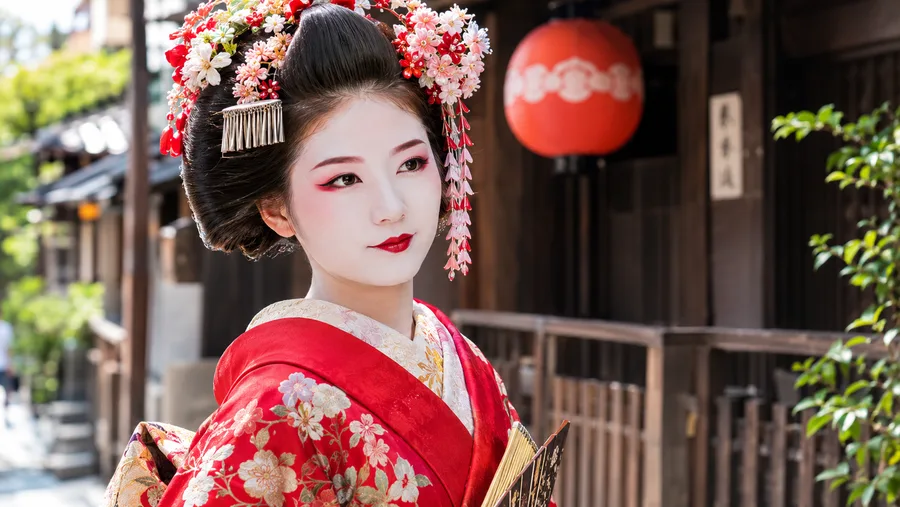
A maiko wears vibrant, long-sleeved kimonos with fluttering dangling sashes (darari obi) that reach almost to her ankles. Her hair is sculpted entirely from her own real locks, decorated with dangling silk flower pins called kanzashi that sway with every step. She wears tall wooden platform sandals called okobo that require a delicate, rolling gait to avoid tripping. Her makeup is bright, dramatic, and heavily stylized.
A full geiko presents a much quieter, more mature elegance. She wears shorter-sleeved silk robes with shorter obis tied neatly against her back. Her hair ornaments are minimal, often just a single comb made of tortoiseshell or polished wood. Most importantly, a geiko wears an artisan-made wig (katsura) styled in classical fashion rather than styling her own natural hair every week. Her look whispers refinement, whereas the maiko screams youthful celebration.
| District (Hanamachi) | City | Approx. Artists | Primary Annual Festival | Atmosphere |
|---|---|---|---|---|
| Gion Kobu | Kyoto | 80 - 100 | Miyako Odori (April) | Historic, grand, famous |
| Pontocho | Kyoto | 40 - 50 | Kamogawa Odori (May) | Narrow riverside alleyways |
| Miyagawacho | Kyoto | 50 - 60 | Kyo Odori (April) | Artistic, tight-knit community |
| Kamishichiken | Kyoto | 25 - 30 | Kitano Odori (March) | Oldest quarter, quiet, relaxed |
| Asakusa | Tokyo | 20 - 30 | Asakusa Odori (Variable) | Lively, Edo-style performance |
Where to Encounter Geisha Culture Respectfully Today
If you wander into Gion around 5:30 in the evening, you might spot an artist stepping out of an alleyway to catch a taxi toward an appointment. For practical route advice on these neighborhoods, take a look at our walkthrough on where to see geisha in Kyoto before heading out. Please understand that watching from a respectful distance is fine, but chasing women down cobblestone alleys is unacceptable behavior that has caused immense friction between locals and overseas visitors.
Kyoto authorities took dramatic steps in late 2019 and again recently, putting up multilingual warning signs and imposing fines of up to 10,000 yen for taking photos in private alleyways around Gion. When an artist is heading to an ozashiki, she is actively on the clock. Her layered kimono weighs over twenty pounds, her shoes require careful balance, and she is expected to arrive at the teahouse at an exact minute. Swarming her with selfie sticks is not just rude, it actively interferes with her livelihood.
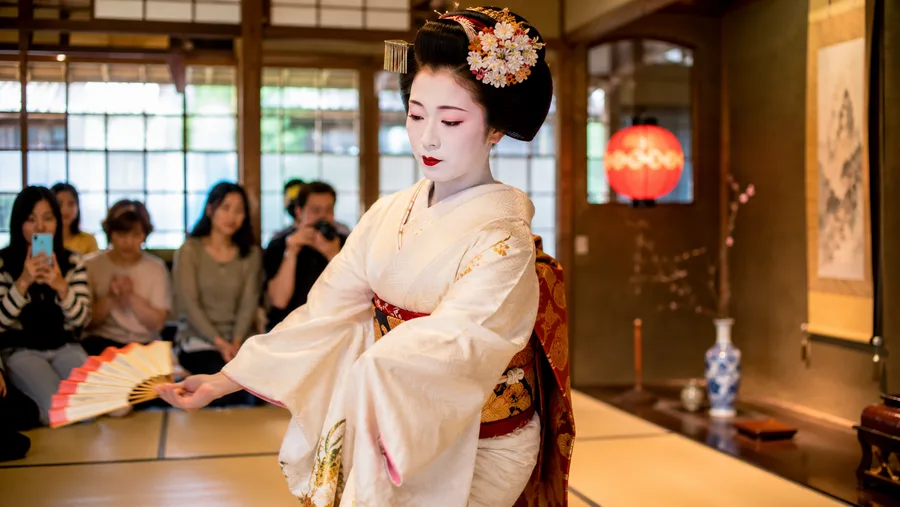
The best way to experience their world is through established, legitimate channels. You can purchase public theater tickets to seasonal odori dance festivals, attend special cultural preservation events, or book a private tea ceremony hosted by an apprentice. Some high-end ryokan and boutique travel planners can now arrange authentic banquets for international visitors with English-speaking guides present to translate the poetry and songs. It costs around 50,000 to 120,000 yen for an evening, but it supports the women directly while preserving an art form that receives zero government subsidy.
Frequently Asked Questions about do geishas still exist
Do geishas still exist in Kyoto today?
Yes, Kyoto is home to five active floral districts known as the gokagai, where around 250 geiko and maiko live, practice, and work daily.
Can foreigners hire a geisha for dinner?
Traditionally, teahouses required an existing client introduction (ichigensan okotowari). Today, select luxury hotels and licensed cultural agencies can arrange authentic private dinners for international travelers.
How old are geishas when they start?
In Kyoto, aspiring maiko typically begin their training at age fifteen after completing compulsory junior high school. In Tokyo, women can start training as geisha at age eighteen or older.
Are modern geishas allowed to have social media?
Apprentice maiko cannot run public personal social media accounts during their training. Independent geiko may use personal smartphones in private life, but the teahouse community maintains strict discretion regarding banquets and clients.
Quick Reference
- Active geiko and maiko in Japan: roughly 600
- Kyoto's main geisha district: Gion Kobu
- Average training start age: 15 years old
- Can working geishas marry: no, they must retire
- Primary art forms: classical dance, shamisen, nagauta
Book your geisha show kyoto experience:
My Take on Geisha Culture Today
Standing on the corner of Hanami-koji as the paper lanterns flicker on, you realize how rare this pocket of reality is. Everything around us moves toward digital convenience, flat screens, and rushed meals. Yet inside these cedar teahouses, twenty-year-old women still spend thirty minutes applying white mineral paste to their necks and hours memorizing folk songs written when samurai walked the castle grounds. The flower and willow world is fragile, yes, but it is stubbornly alive. If you visit Kyoto with patience, quiet curiosity, and genuine respect for their space, seeing this ancient craft in person is an experience you will never forget.
Read more about geisha show kyoto.